
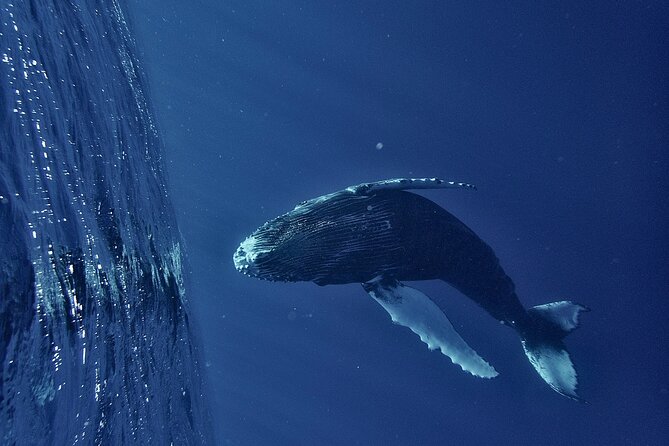
REVIEW · HUMPBACK WHALE TOURS IN FRENCH POLYNESIA
Whale watching DE Humpback West Coast of Tahiti
Whales make Tahiti feel wonderfully wild. This four-hour excursion from Puna’auia gives you a small-group chance to watch humpbacks in their warm-season waters, with the added possibility of entering the ocean near them when conditions and rules allow. I like the maximum group size of eight, which keeps the boat personal, and I like that the crew provides safety gear, snorkeling equipment, water, hot drinks, and snacks.
I also appreciate the clear safety limits. A swim with a whale is never promised, and it is not suitable for children under 12 or for anyone who cannot swim confidently. The main drawback is simple: you may spend the whole trip watching from the boat without getting into the water, and whale sightings themselves are not guaranteed.
- Humpback season runs from July 20 to November 20, subject to approval from French Polynesia’s environmental authority.
- The boat leaves at 7:30 am from Pontons Taapuna in Puna’auia and returns there after roughly four hours.
- The group is limited to eight people, with no more than six swimmers plus one guide in the water.
- Jordan and Romuald are praised for warm, capable service, adding a friendly human touch to the trip.
- Swimming with whales requires real ocean confidence, including the ability to swim 200 meters without help.
- Cancellation is free up to 24 hours before departure, while poor weather may lead to a new date or full refund.
Why Tahiti Is a Humpback Whale Destination
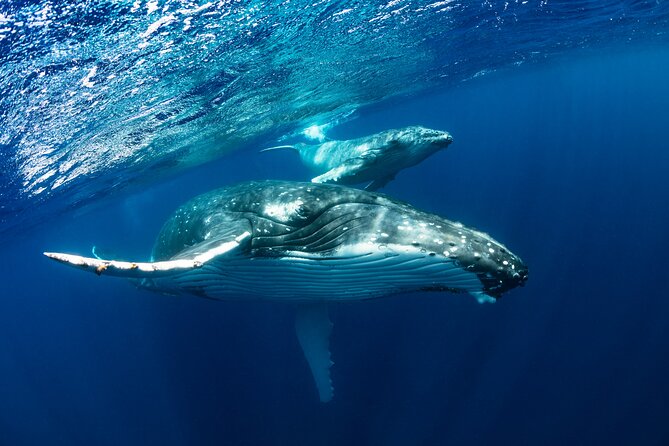
Each year, humpback whales leave the cold waters around Antarctica and travel north into the southern Pacific. They come to warmer waters to breed, give birth, and raise their young before returning south toward the end of November.
That seasonal pattern gives this outing its purpose. You are not simply taking a boat ride and hoping something large appears. You are visiting during a known part of the whales’ annual cycle, when mothers, calves, and adult males may be present.
The timing still matters. The official observation season is July 20 through November 20, and approval from DIREN, French Polynesia’s environmental authority, is required. The period described for the strongest activity is from October until the return migration begins late in November, but nature does not follow a neat calendar.
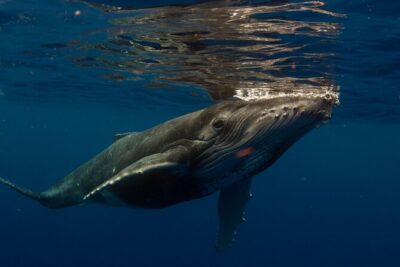
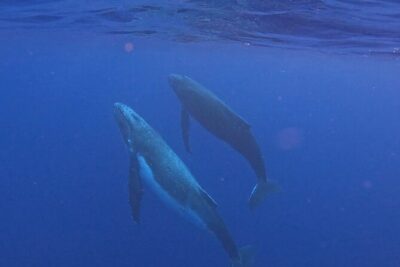
I would plan this as a wildlife outing, not a guaranteed appointment. You might see several groups of whales. You might see a mother and young whale. You might watch from a distance while the animals remain underwater. All three outcomes are part of a responsible whale-watching trip.
Meeting at 7:30 am in Puna’auia
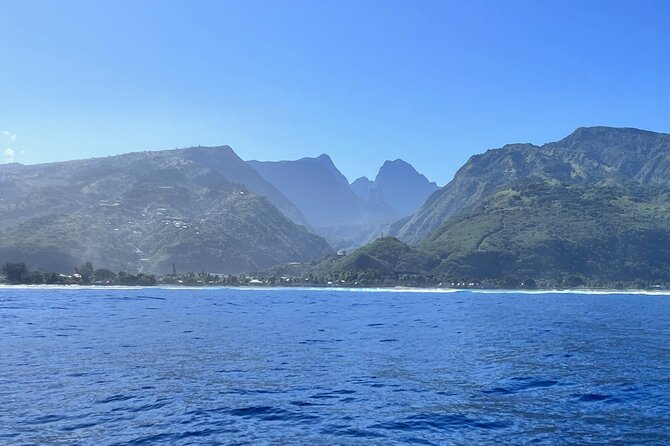
The meeting point is 3 Pontons Taapuna in Puna’auia, on Tahiti’s west coast. The activity starts at 7:30 am and ends at the same location.
That early start is useful for two reasons. First, it gives you a full morning on the water without taking the entire day. Second, a four-hour outing leaves room for other plans in Tahiti, though you should allow extra time around the stated duration if the crew needs to wait for whales or sea conditions.
Pickup is not included, but it may be arranged on request. Ask about this before booking rather than assuming transport is part of the price.
At the pontoon, the crew welcomes you aboard the locally built boat. The boat is described as comfortable and adapted for this activity, with safety equipment and snorkeling equipment supplied. You will also receive bottled water, coffee or tea, and snacks.
Those small provisions matter more than they sound. A morning on open water can feel long if you are cold, hungry, or thirsty. Here, the basics are covered, so you can focus on the animals and the sea.
More Humpback Whale Tours in French Polynesia
- Swim with humpback whales
★ 5.0 · 224 reviews - Humpback whale watching and marine life in Moorea
★ 5.0 · 199 reviews - Private tour observing and swimming with humpback whales in Moorea
★ 5.0 · 126 reviews
A Small Boat With a Personal Feel
With a maximum of eight people, this is much smaller than a large whale-watching vessel. That does not guarantee a better sighting, but it does make the outing easier to manage.
You are likely to have a clearer view of the guides’ explanations and a better chance to ask questions. The crew can also keep closer track of everyone when the group moves between boat observation and snorkeling activity.
The small capacity has a practical limit, too. Only six swimmers plus one guide may be in the water at once. If everyone wants to enter, there may be a short wait while the crew manages the group safely.
The crew includes a professional guide and captain. Jordan and Romuald are specifically praised for their friendly treatment and strong handling of the excursion. Their role is not just to steer the boat. They explain the species you encounter, describe whale behavior, and decide when an approach or water entry is appropriate.
Watching the Whales From the Boat
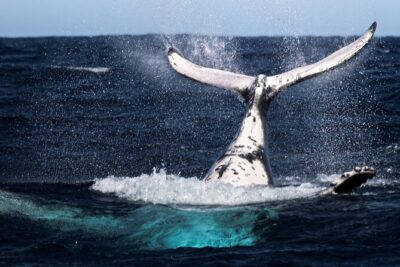
The main part of the outing is observation from the boat. The crew looks for humpbacks and explains their way of life as the trip unfolds.
This is the part I would value most if you prefer wildlife watching without physical exertion. You can remain on board, listen to the guide, and enjoy the encounter without needing to swim near a large marine animal.
The whales can weigh from one to 30 tonnes, according to the safety information. That range helps explain the careful approach rules. Even a calm whale is a powerful wild animal, and the crew has the right to change plans in the best interest of everyone on board.
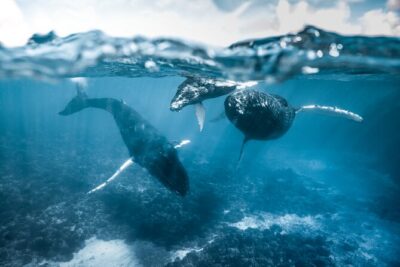
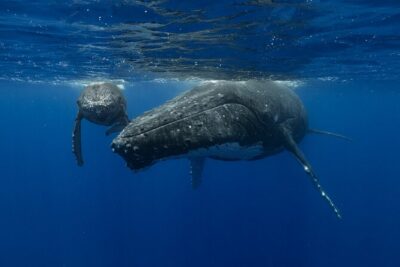
The sightings can be especially moving when young whales are involved. The provided accounts describe encounters with several groups and a young male that was singing. One account also describes seeing a whale and its young. These are remarkable possibilities, but they should be treated as fortunate outcomes rather than promises.
The rules governing approach are set by French Polynesia. The crew must follow the permitted distance and interaction standards, even if a whale appears close to the boat. That may occasionally feel cautious, but it is exactly what you want from a responsible wildlife operator.
The Optional Water Entry Near the Whales
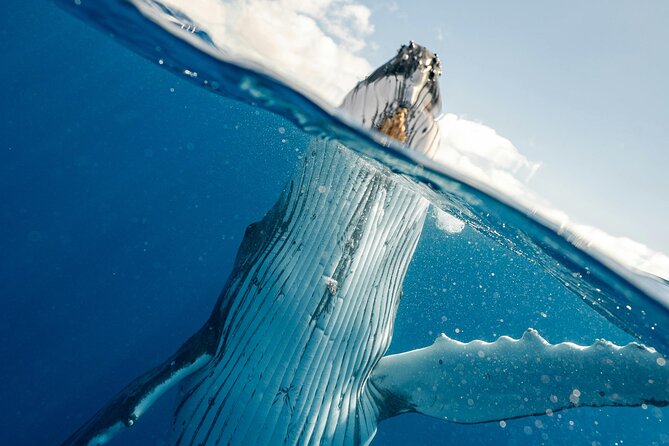
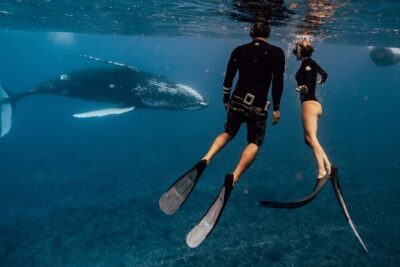
The most exciting possibility is entering the water near the whales. It is also the part that requires the most care.
The launch is optional, not automatic. Conditions must be right, the crew must approve it, and the animals’ behavior must make it appropriate. You may watch the whales from the boat for the full outing, and that still counts as a complete experience.
To enter the water, you must be able to swim at least 200 meters without assistance. You also need to feel comfortable in the open ocean, including getting in from the boat, and you must not panic around very large marine animals.
Children under 12 may not enter the water with whales. Children from 12 to under 18 need parental permission. If you are unsure about a child’s confidence, the safer option is to let them remain on board as an observer.
The maximum in-water group is six swimmers plus one guide. This rule keeps the water group controlled and gives the guide room to monitor everyone.
The supplied equipment includes snorkeling gear and safety equipment. Still, gear does not replace confidence. If you are an uncertain swimmer, an adult observer, or someone recovering from an injury, staying aboard may be the wiser choice.
Same water, a different way to meet them:
- Swimming with Whales in Moorea (Half Day tour)
★ 4.5 · 264 reviews - Whale Tour – Observe and swim with whales
★ 5.0 · 257 reviews - Whale Watching Tours in Bora Bora
★ 4.5 · 250 reviews - Half day whale tour 4h00
★ 4.5 · 181 reviews
What the Four-Hour Schedule Feels Like
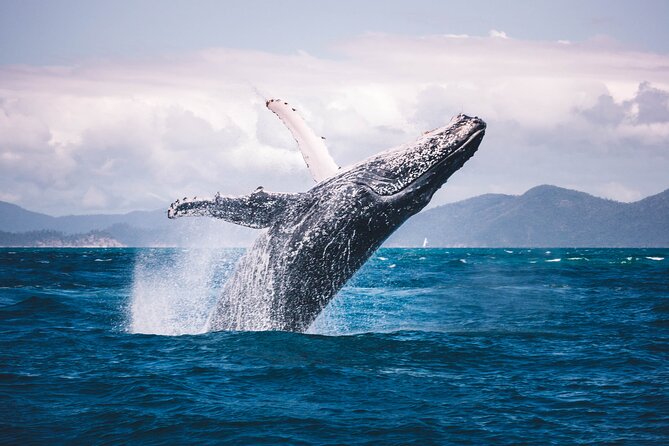
The outing is listed at approximately four hours, with the average visit lasting three to four hours. The actual rhythm depends on the whales and the sea.
You begin with boarding and a welcome from the crew. The guide can explain the activity, the safety rules, and the behavior expected around marine mammals. Pay close attention here, especially if you hope to enter the water.
The boat then heads out to look for humpbacks. There is no fixed sightseeing route described, so the time is centered on finding and observing the whales rather than stopping at a series of named attractions.
If whales are found, the crew explains what you are seeing and determines how to approach. You may watch from the boat, and in suitable conditions the guide may offer a water entry.
After the wildlife portion, you return to the Taapuna pontoon. Water, coffee or tea, and snacks are included during the outing. The trip does not include hotel pickup unless separately arranged.
What the $167.34 Price Buys You
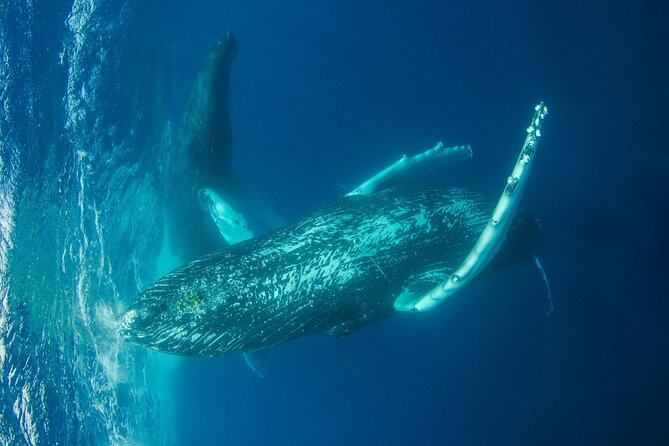
At $167.34 per person, this is not a casual harbor cruise. The price covers about four hours, a professional captain and guide, a small group, safety equipment, snorkeling equipment, bottled water, hot drinks, and snacks.
The value depends on what you want from whale watching. If your priority is a guaranteed swim, the price may feel high because entering the water is never guaranteed. If your priority is a carefully managed encounter with a small group and the possibility of seeing humpbacks in their seasonal waters, the cost is easier to justify.
The group limit is an important part of the value. You are not paying for a large boat filled with people and a quick glimpse over the side. You are paying for a more personal outing where the crew can explain behavior and manage the water activity closely.
I would also remember that wildlife tours carry an unavoidable risk of disappointment. The whales may be elsewhere, weather may change, or conditions may not permit a launch. A fair price does not turn nature into a performance.
The Best Fit for This Whale Tour
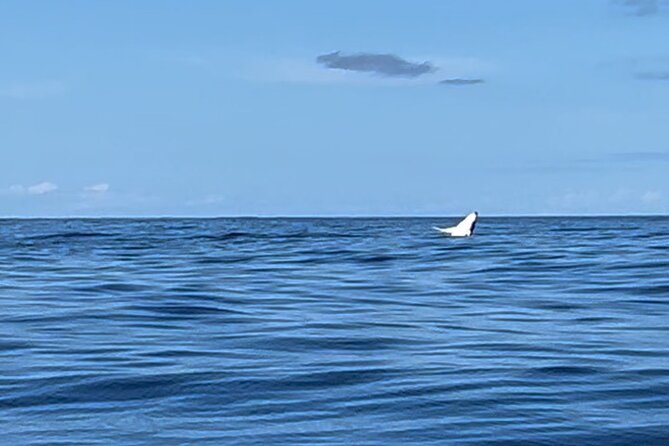
This outing suits you if you want a focused morning on the water and you are comfortable with uncertainty. It is especially suitable for adults and older children who can follow instructions and, if they wish to swim, meet the physical requirements.
It also works well for mixed groups. Strong swimmers can hope for a water entry while less confident participants remain on the boat. Children under 12 can participate as observers, but they cannot launch with the whales.
You should have a moderate level of physical fitness. If you have reduced mobility, a temporary injury, or another special need, contact the operator in advance. The crew will try to adapt the welcome and arrangements as well as possible.
This is not the right choice if you need guaranteed animal contact, dislike open-ocean conditions, or cannot accept a boat-only experience. The whales decide the terms.
Safety, Rules, and Responsible Expectations
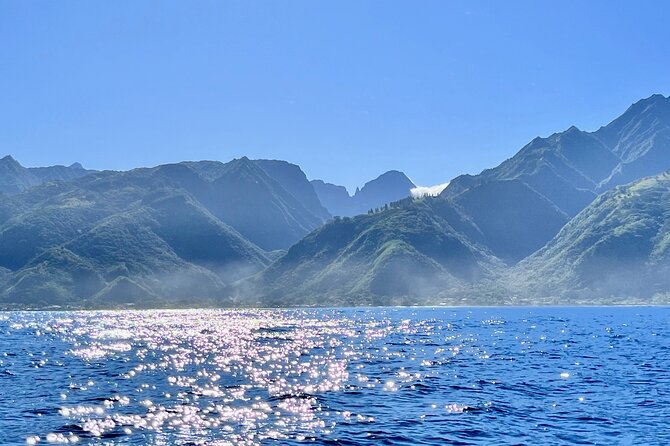
The strongest feature of the safety policy is its honesty. The excursion clearly says that observations are not guaranteed, launches are not mandatory, and water entries are not systematic.
That wording protects you from building the day around an outcome nobody can control. It also signals respect for the whales. The crew must follow French Polynesia’s approach rules and can stop or change an activity when conditions are not suitable.
Do not treat the swim as a standard snorkeling stop. You are entering the ocean near animals that may weigh many tonnes. You need to be calm, physically capable, and ready to follow the guide without hesitation.
A practical tip is to decide before boarding whether you are genuinely comfortable with the water requirement. You do not need to prove anything. Remaining on the boat is a completely valid way to take part.
Weather, Cancellations, and Advance Planning
You can cancel for a full refund if you do so at least 24 hours before the local start time. Changes or cancellations made within 24 hours are not refunded.
The outing requires suitable weather. If poor conditions force a cancellation, you are offered another date or a full refund. If the minimum number of participants is not reached, the same choice applies, with another date, another experience, or a full refund.
The experience is booked an average of 18 days in advance, so I would avoid leaving it until the last moment during whale season. Confirmation is normally received when you book. If you book within one day of departure, confirmation comes as soon as possible and depends on availability.
Because whale encounters depend on both nature and permission, booking early is useful, but leaving some flexibility in your Tahiti schedule is even better.
Should You Book This Tahiti Whale Tour?
I would book it if you want a small, carefully managed humpback outing and understand that watching from the boat may be the final result. The chance to see several groups, a young whale, or a singing male can be extraordinary, but none of those outcomes is promised.
The strongest reasons to choose it are the eight-person maximum, the friendly crew led by guides such as Jordan and Romuald, and the clear safety rules. The main reason to hesitate is the price combined with uncertainty. You pay for time, expertise, equipment, and a genuine chance at a rare encounter, not for guaranteed swimming.
If you are a confident ocean swimmer and the possibility of entering the water matters to you, this may be a memorable choice. If you are traveling with children under 12 or prefer dry, predictable sightseeing, plan to observe from the boat and judge the experience on that basis.
FAQ
Where does the whale-watching tour begin?
It begins at 3 Pontons Taapuna in Puna’auia, French Polynesia.
What time does the tour start?
The scheduled start time is 7:30 am.
How long does the experience last?
The tour lasts approximately four hours. The average visit is described as three to four hours.
When is humpback whale watching allowed?
The observation period is allowed from July 20 through November 20, subject to approval from DIREN.
Is swimming with the whales guaranteed?
No. Launching is optional and is not systematic. The crew decides based on conditions, safety, rules, and whale behavior.
How many people can join the tour?
The maximum group size is eight people.
How many swimmers may enter the water?
A maximum of six swimmers and one guide may be in the water at one time.
Can children swim with the whales?
Children under 12 may not enter the water with whales. Participants aged 12 to under 18 need parental authorization.
What is included in the price?
The price includes a guide, safety equipment, bottled water, coffee or tea, snacks, and snorkeling equipment. Pickup may be available on request but is not included as a standard feature.
Just added around French Polynesia
- Whale Watching Activity★ 5.0 · 8 reviews
- Tahiti, land of whales: a unique experience!★ 5.0 · 11 reviews
- Observe and Swim with Whales in Tahiti★ 4.5 · 14 reviews
- Whale watching DE Tahiti Peninsula★ 5.0 · 12 reviews
- Whale watching in the calm of the peninsula with Tātahi tours★ 5.0 · 6 reviews
- Half Day Whale Watching in a Small Shared Group★ 5.0 · 33 reviews
- 4 Hours of Humpback Whale Watching in Tahiti★ 5.0 · 36 reviews
- Whale watching and snorkelling in Moorea★ 5.0 · 64 reviews
Humpback Whale Tours in French Polynesia, compared.
Humpback whale watching and marine life in Moorea
Read our review →
Private tour observing and swimming with humpback whales in Moorea
Read our review →
Browse the lists this tour appears in